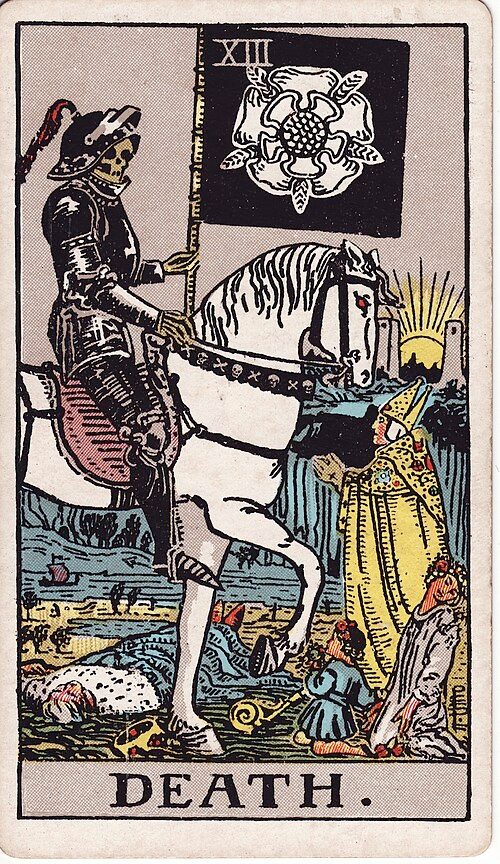
Death
Upright
Transformation · Endings · Release
Something is ending so that something else can begin, and the card asks you to let it. This is not loss for its own sake but transformation, the necessary clearing away of what has finished so the ground is free for what comes next. Deep and unsentimental, it carries the truth that release is the doorway, and that holding a dead thing upright helps no one.
Reversed
Clinging · Stagnation · Fear
You are clinging to what has already ended, keeping a finished chapter propped open out of fear of the blank page. The stuckness is not the ending itself but your refusal of it; nothing new can arrive while your hands are full of what is over.
In love, money & work
Love may be shedding an old form, and letting a chapter or a pattern truly end is what clears space for something more honest to grow.
A financial arrangement or habit may have run its course, so release what no longer serves rather than pouring resources into a sunk cost.
An ending at work, however unwelcome, is making room for a genuine next step, so let the old role close cleanly instead of clutching at it.
Death as a person
Someone in the middle of becoming a different person, who has already let go of who they were. Being near them tends to change you too.
Death as feelings
Something between you has ended, whatever the labels still say. What comes next can be real, but not as a continuation of what it was.
Death: yes or no?
No
Not in its current form. Something has to end here before anything else is possible.
Let go of one thing today that you have known for a while is already over.
A deeper reading
At its core, the Death card represents the absolute necessity of clearing away what has finished so the ground is free for what comes next. It is the card of profound transformation, insisting that something must end so that a new beginning can take root.
The most common misunderstanding of this card is the assumption of physical loss or tragedy. Tarot readers understand it instead as a psychological and spiritual transition, a deep and unsentimental truth that release is the only doorway to genuine renewal.
The Symbolism of Death
In traditional depictions, a skeletal figure clad in black armor rides a pale horse, representing the unstoppable march of time and change that spares no one. The armor is dark and impenetrable, showing that the force of endings is absolute and cannot be bartered with or avoided.
Beneath the horse, figures from all walks of life lie fallen or kneeling, from a crowned king to a young child. This illustrates that transition is a universal law, indifferent to worldly status, wealth, or power, leveling all structures to make way for the new.
In the background, a river flows toward the horizon where the sun rises between two distant pillars. The water speaks of the fluid, emotional nature of change, while the rising sun serves as a powerful reminder that every ending is intimately bound to a new dawn.
Death in a Spread
In the past position, the card points to a major door that has already shut, forming the silent foundation of the current situation.
In the present position, it indicates a time of active shedding where holding onto the status quo only creates unnecessary friction.
In the future position, it suggests an inevitable transition ahead that requires a willingness to let go of old identities.
In the advice position, the card asks for the conscious release of one specific thing that has been over for a long time.
In the outcome position, it represents a complete clean slate, showing that the final result will look entirely different from how things began.
The Deeper Lessons of Transition
In matters of the heart, this card suggests that relationships must periodically shed their old skin to survive. When a long-standing pattern or an outdated way of relating has run its course, attempting to keep the old form alive prevents a more honest connection from developing.
Regarding work and material resources, the card warns against pouring energy into sunk costs or clinging to a professional identity that no longer fits. Letting a project, role, or financial habit close cleanly is the only way to free up the resources required for the next professional chapter.
Within the inner life, the card represents the quiet, necessary ego-death that precedes psychological growth. It demands a surrender of old self-images and beliefs, inviting a period of empty space where the spirit can rest before the next cycle of creation begins.
What Changes the Reading
When reversed, the natural flow of transformation is blocked by a refusal to accept what has already ended. The resulting stagnation and discomfort do not come from the transition itself, but from the tight grip of fear trying to keep a finished chapter propped open.
As card thirteen of the Major Arcana, Death carries the watery, intense energy of Scorpio, a sign associated with deep truth beneath the surface and an all-or-nothing approach to life. This astrological connection emphasizes that the card is not about superficial adjustments, but a complete elemental rebirth.
When surrounded by cards of the suit of Cups, the focus shifts to emotional clearing and grieving what is lost. Beside Swords, the ending is often swift, intellectual, and decided by a sharp cut of truth, while Pentacles suggest tangible, physical structures that are finally breaking down to yield new soil.
Questions
- Does the Death card ever mean physical death?
- In modern tarot practice, the card almost never refers to physical death. It is read as a metaphor for psychological endings, major life transitions, and the natural cycles of regeneration.
- Is Death a positive or negative card?
- It is neutral and necessary. While the process of letting go can feel uncomfortable or painful, the ultimate purpose of the card is renewal and the creation of space for better things.
- What does it mean when the Death card keeps appearing?
- Repeated appearances suggest a strong resistance to an ending that needs to happen. It serves as a persistent reminder to stop holding onto what is already gone.
Correspondences
Death is attributed to — read the Scorpio sign.